The Ayurvedic Science of Food Combining
Oct 06, 2026
When we think about healthy eating, we tend to focus on individual foods. Is it nutritious? Is it fresh? Does it contain enough protein, fibre, vitamins or minerals? Ayurveda considers the qualities of individual foods too, but it also includes another consideration: how will the foods within this meal behave in the gut once eaten? Thus is the Ayurvedic understanding of “food compatibility.”
Classical Ayurveda describes the concept of Viruddha Ahara, usually translated as incompatible, antagonistic or contradictory food. The principle is much broader than the food-combining charts we often see today. Ayurveda considers not only what we eat, but how foods are combined, prepared and consumed, the quantity we eat, the season and environment, and of course, the digestive capacity of the individual.
This gives us a more nuanced way of thinking about nutrition. Two foods may each have value individually, yet Ayurveda may not consider them an ideal combination. Similarly, a meal that works well for one person may be unnecessarily difficult for another to digest.
For anyone new to Ayurveda, food combining can initially feel like another long list of dietary rules, although we should try not to approach it that way. The purpose is not to become anxious about every ingredient on your plate, but to better understand digestion, simplify where appropriate and become more observant of how food actually makes you feel.
What Is Viruddha Ahara?
The classical Ayurvedic concept underlying food compatibility is Viruddha Ahara. Viruddha refers to something incompatible, opposing or contradictory, while Ahara means food or nourishment.
One of the major discussions of Viruddha Ahara appears in the Charaka Samhita, Sutrasthana, Chapter 26: Atreyabhadrakapiya Adhyaya. Charaka describes numerous forms of dietary incompatibility and gives specific examples of foods and preparations considered unsuitable together. Incompatibility in Ayurveda is not limited to two ingredients appearing on the same plate. Food may be considered unsuitable because of the combination itself, but also because of factors such as preparation, processing, quantity, timing, season or the circumstances in which it is consumed. The Ashtanga Hridaya, Sutrasthana, Chapter 7: Annaraksha Adhyaya also discusses Viruddha Ahara and provides examples of incompatible foods.
This broader classical context is important because modern discussions of Ayurvedic food combining can sometimes reduce a sophisticated dietary framework to lists of “eat this” and “never combine that.” However the classical approach is considerably more nuanced.
Ayurveda Asks More Than “Is This Food Healthy?”
Ayurvedic nutrition doesn’t evaluate food solely according to its nutrient content. Foods are also understood according to characteristics such as Rasa (taste), Guna (qualities), Virya (potency or energetic effect) and Vipaka (post-digestive effect), alongside their influence on the Doshas and digestion.
This means the Ayurvedic question is not simply: Is this a healthy food?
It is also: Is this food appropriate for this person, prepared in this way, in this quantity, at this time?
That distinction is especially important in modern wellness culture, where there can be a tendency to assume that adding more nutritious ingredients automatically creates a healthier meal. Consider a smoothie containing several fruits, yoghurt or milk, protein powder, nut butter, seeds, greens, supplements and assorted superfoods. Each ingredient may have nutritional value individually. From an Ayurvedic perspective, however, we would also consider the digestive complexity of combining many foods with different qualities into a single meal.
Sometimes, more nutrition on paper does not necessarily mean easier or better digestion. Sometimes, simpler really is better.
Why Does Food Combining Matter?
Central to Ayurvedic nutrition is Agni, our capacity to digest, transform and assimilate what we consume. This changes the conversation around healthy eating. It’s not enough simply to consume nourishing food; we also need to be able to digest and utilise it effectively.
The importance of quantity and digestibility is discussed in the Ashtanga Hridaya, Sutrasthana, Chapter 8: Matrashitiya Adhyaya, which considers appropriate quantities of food in relation to digestive capacity and the relative heaviness or lightness of foods.
Similarly, the Charaka Samhita, Sutrasthana, Chapter 27: Annapanavidhi Adhyaya provides an extensive discussion of food and drink and their different qualities and effects.
When food is unsuitable for our digestive capacity, Ayurveda describes the possibility of incomplete digestion and the development of Ama, a traditional concept referring broadly to material that has not been properly digested, transformed or assimilated. In everyday life, we may simply notice that certain meals repeatedly leave us feeling excessively heavy, bloated, gassy, sluggish or tired. We may notice that our appetite disappears for many hours after eating, or that a complicated meal makes us feel very different from a simple one. Ayurveda encourages us to pay attention to these experiences rather than judging a meal only by its ingredients.
What Does Classical Ayurveda Actually Say About Food Combining?
There is an important distinction to make here.
Many contemporary Ayurvedic food-combining charts contain recommendations that have become common within modern Ayurvedic nutrition but are not necessarily direct statements from the classical texts. For example, broad recommendations such as “always eat fruit alone” are widely taught in contemporary Ayurveda, but it would be misleading to suggest that Charaka provides a simple universal rule stating that all fruit must always be eaten separately.
The classical texts instead provide specific examples of incompatibility and a broader framework through which foods, combinations and digestive capacity can be assessed.
Here are some useful examples: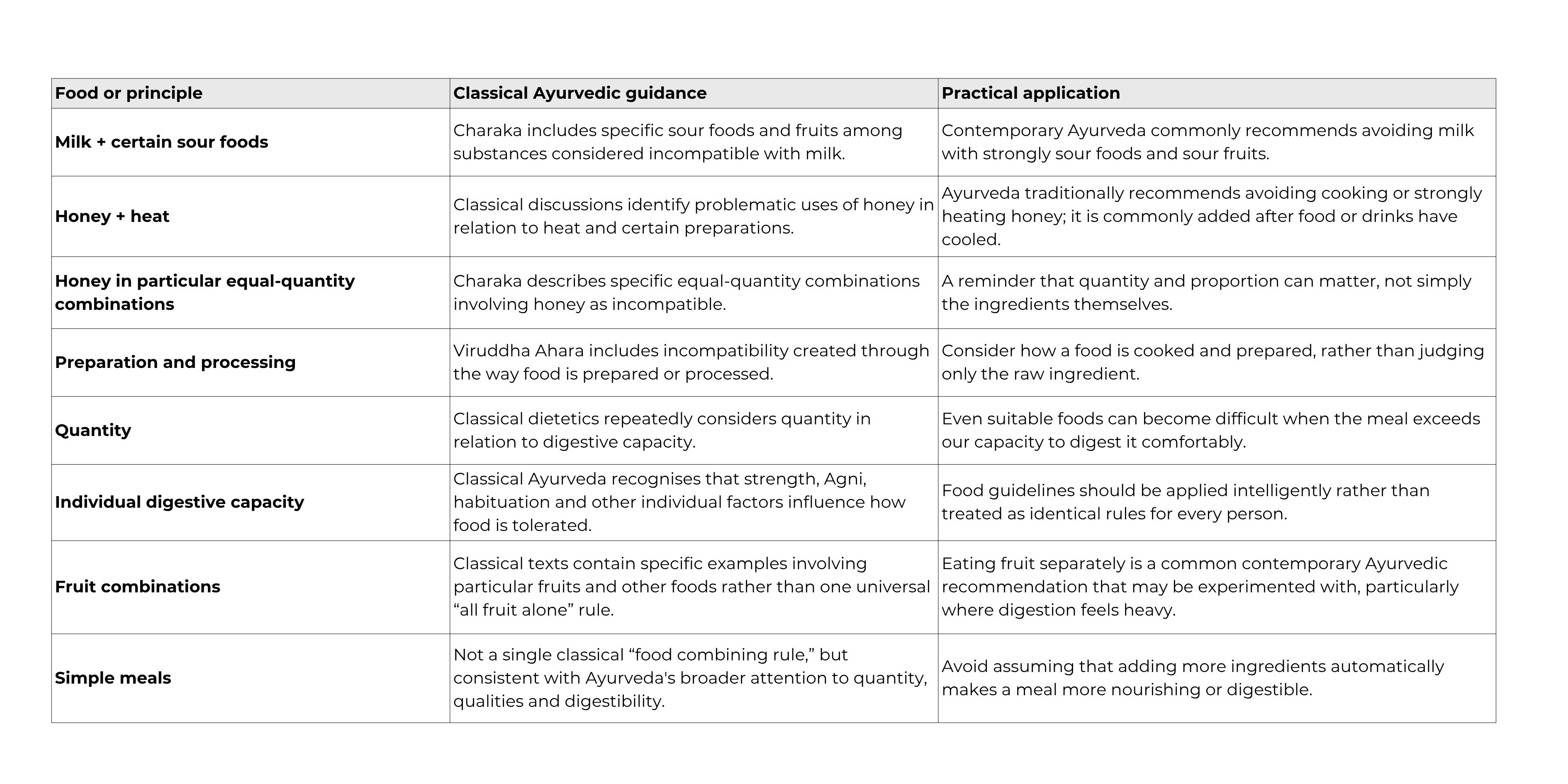
This distinction allows us to respect the classical teachings while still applying Ayurveda within a modern diet.
Milk Is a Good Example of Ayurvedic Food Compatibility
Milk provides one of the clearest examples of why Ayurvedic food combining is more sophisticated than simply categorising foods as healthy or unhealthy. Traditionally, milk is regarded as a highly nourishing food when it is appropriate for the person and properly digested. Yet Ayurveda is also quite particular about what it is combined with. The reasoning is based on Ayurvedic understandings of the qualities and potency of the foods rather than their modern macronutrient classification.
This illustrates a broader principle: a food can be considered nourishing while still being inappropriate in a particular combination.
What About Fruit?
Fruit is one area where it is useful to distinguish classical Ayurveda from contemporary Ayurvedic teaching. Modern Ayurveda commonly recommends eating fresh fruit separately, particularly rather than combining it with heavy meals or large amounts of dairy. Melons are also commonly recommended to be eaten alone. These can be useful practical guidelines, particularly for someone who experiences bloating, heaviness or digestive discomfort after mixed meals.
However, we should be careful about attributing a universal “fruit must always be eaten alone” rule directly to Charaka or Vagbhata. Classical discussions are generally more specific, identifying particular combinations rather than treating all fruit as one interchangeable category.
A practical approach is therefore to experiment. If you routinely eat fruit as part of a large, complicated breakfast and regularly experience digestive discomfort, try eating the fruit separately for a period and observe whether anything changes. The point is not to become frightened of combining a strawberry with something else. It is to develop greater awareness of your digestion.
A Note on Honey
Honey is another common example of why preparation matters in Ayurveda. Classical Ayurvedic texts place specific conditions around the use of honey, including warnings associated with particular combinations, proportions and exposure to heat. This has led to the longstanding Ayurvedic recommendation that honey should not be cooked or strongly heated. In practical terms, contemporary Ayurvedic practice commonly recommends allowing hot drinks or foods to cool before adding honey rather than boiling or cooking it.
It is important, however, to present this accurately. This is a traditional Ayurvedic dietary principle, not a claim that contemporary nutritional science has established ordinary heated honey as toxic. And the definition of toxic in traditional terms often differs from modern medical terminology. So in a sense, two truths can exist – heated honey doesn't honour it’s ideal state and if consumed regularly may lead to Ama. Is heated honey toxic in that it will make you sick? Probably not. We can respect the Ayurvedic tradition without confusing its theoretical framework with modern biomedical evidence.
Your Digestion Is Part of the Conversation
One of the most useful aspects of Ayurveda is that dietary recommendations do not exist entirely separately from the person eating the food. Classical Ayurveda considers constitution, current balance, age, season, environment, habits, quantity, strength and digestive capacity.
The Ashtanga Hridaya's discussion of incompatible foods is interesting because it also recognises that their effects are not necessarily identical in every individual. Factors including strong digestion, physical strength, exercise and habituation can influence how food is tolerated. This is a much more nuanced position than many modern “Ayurvedic food rules” suggest.
A chart can provide guidance, but your digestive experience also provides information.
(This would be my key guiding principle for applying all Ayurvedic Nutrition principles).
How hungry were you before eating? Did you finish the meal feeling comfortably satisfied or excessively full? Did you experience bloating or heaviness afterwards? Did the meal give you sustained energy, or did you immediately want to sleep? Did a clear appetite return by your next meal? These simple observations can begin to tell us something about our relationship with food and Agni.
Of course, persistent or concerning digestive symptoms should not simply be self-diagnosed as an Ayurvedic imbalance and warrant appropriate healthcare assessment. Ayurveda can provide a framework for self-observation without replacing necessary medical care.
Don't Be Scared of the “Rules”
This is perhaps the most important part. When people first begin studying Ayurveda, food combining can quickly become overwhelming. Suddenly your smoothie is “wrong.” Your breakfast contains three supposedly incompatible ingredients. Your favourite recipe breaks five rules, and eating becomes an intellectual exercise in trying not to make a mistake. That is not a particularly helpful way to use Ayurveda. Food should nourish us, and our relationship with food matters too. Turning Ayurvedic nutrition into another rigid system of dietary control can easily undermine the awareness we were trying to cultivate in the first place.
Instead, learn the principles and apply them gradually.
Perhaps you start by paying more attention to combinations involving milk. Maybe you stop cooking honey. Perhaps you try eating fruit separately and see whether it changes your digestion. You simplify a breakfast containing ten different ingredients into something containing five. Or you notice that a particular meal consistently makes you feel heavy and experiment with changing one element.
You do not need to practice every principle perfectly for Ayurveda to be useful.
Learn the principles. Apply what is practical. Observe how you feel.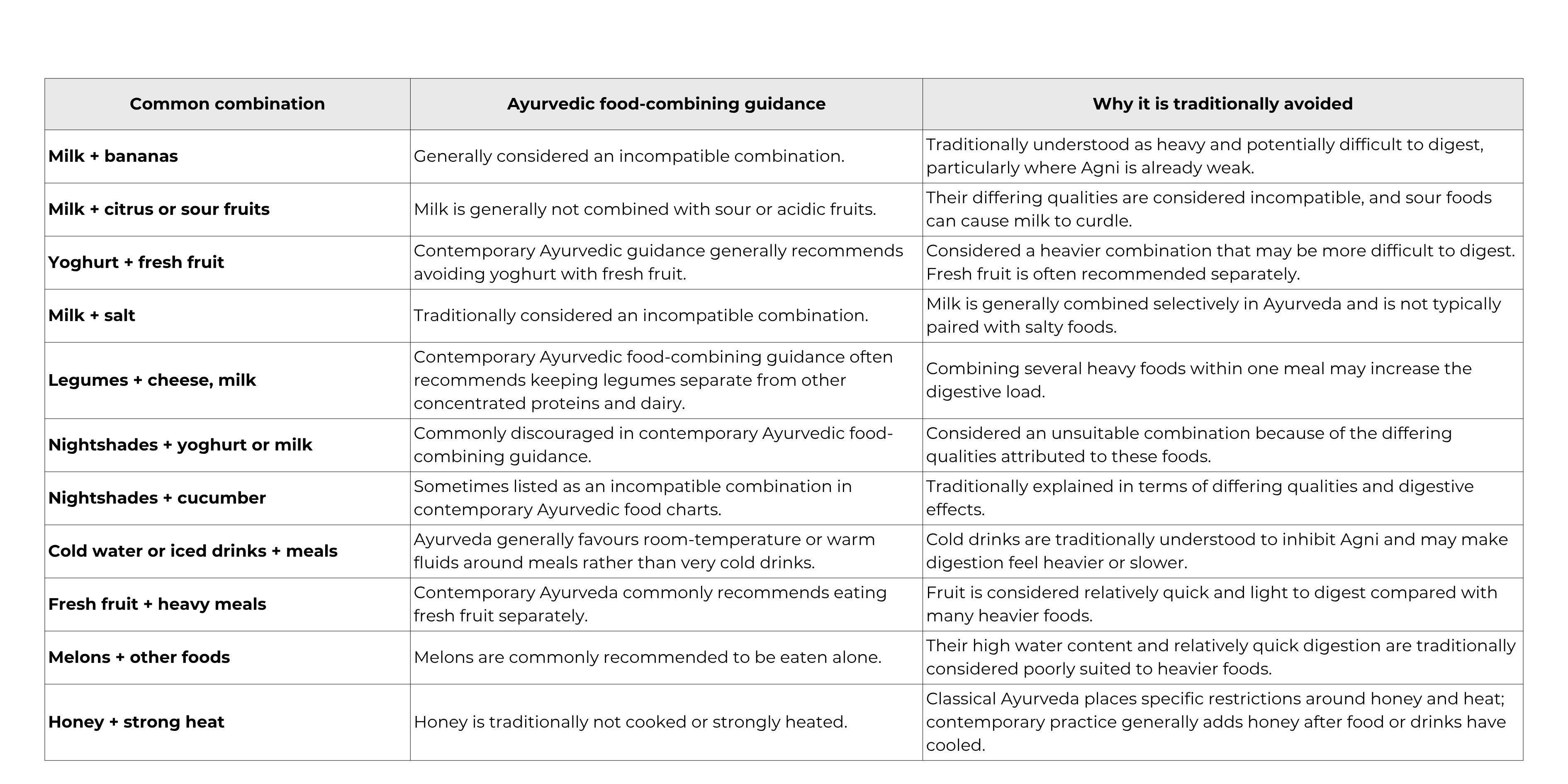
Start With the Meals You Eat Most Often
If you want to explore Ayurvedic food combining, there is no need to analyse everything in your pantry. Start with repetition. Look at your breakfast. Your morning smoothie. The way you eat fruit. Your regular lunch. Your favourite dinner. These meals matter because they are the foods and combinations your digestive system encounters again and again.
Choose one or two principles and experiment with them for a period of time. Simplify a complicated meal. Pay attention to your dairy combinations. Try eating fruit separately. Use appropriate culinary spices. Consider whether you are eating a suitable quantity rather than focusing exclusively on the ingredients themselves.
Then observe.
This turns Ayurvedic nutrition from a collection of theoretical rules into something much more useful: a practice of self-study.
Food Combining Should Ultimately Make Eating Simpler
Ayurveda offers an extraordinarily detailed system for understanding food, digestion and health, but detail does not have to mean complication.
In practice, many Ayurvedic dietary principles lead us back towards simplicity: freshly prepared food, sensible quantities, appropriate combinations, regular meals, awareness of appetite and enough attention to notice how we actually feel afterwards. Viruddha Ahara gives us another layer through which to understand this relationship. The intention is not to make us frightened of eating the “wrong” combination. It is to help us become more aware and knowledgeable in how we nourish ourselves. Instead of asking only whether a food is nutritious, Ayurveda encourages us to ask: Is it appropriate for me, and can I digest it well?
That is ultimately the value of Ayurvedic food combining.
Classical Ayurvedic References
Charaka Samhita, Sutrasthana, Chapter 26: Atreyabhadrakapiya Adhyaya, particularly the discussion of Viruddha Ahara and incompatible food combinations around 26.81–84.
Charaka Samhita, Sutrasthana, Chapter 27: Annapanavidhi Adhyaya, discussion of foods, drinks, dietary qualities and digestion.
Ashtanga Hridaya, Sutrasthana, Chapter 7: Annaraksha Adhyaya, particularly the discussion of Viruddha Ahara, incompatible foods and factors influencing their effects.
Ashtanga Hridaya, Sutrasthana, Chapter 8: Matrashitiya Adhyaya, discussion of appropriate food quantity, digestibility and Agni.